
Popular Posts
-
 Maharaja Portraits of Cochin (For the background contained in this post I am deeply indebted to Ron Rice who wrote a clear and detailed art...
-
 Here are 4 illustrations of stamps used during Czarist times and their overprinted versions during the early Soviet takeover of government b...
-
 Illustrated below is a partial set of postage stamps issued by Japanese occupation forces in Burma during World War 2. Issued in 1943 and li...
-
 Below are some illustrations of old stamp albums. They show stamps of the now defunct Indian Princely States.
-
 I like Japanese postage stamps for their design and for the cancels they use on stamps. I think sometimes the stamps are more attractive wit...
-
 Shown below are some of the stamps of Travancore, one of the Princely or Feudatory states of India during the British Raj. Illustrated are...
-
 Illustrated below are George the 5th Indian Empire Stamps showing some of the printings, varieties and overprints issued during his re...
-
 Shown below is a page from an old album of turkish stamps. The last detail below the page is a stamp of Great Britain used abroad with overp...
-
 A joined pair ( still on original card) of the Queensland 2 shilling and Sixpence with a young Queen Victoria head. These stamps were first ...
-
 Below are two illustrations of Italian postage stamps that will be instanly recognised by most people. They show Hitler and Mussolini with t...
Friday, July 29, 2011
Two Postage Stamps of Edward the 8th with Overprint Errors
The postage stamps illustrated below are Edward the 8th definitives for use abroad. These particular stamps were for use in Morocco and were normally overprinted with the geographical location and the equivalent value in local currency. In the two error stamps illustrated the location is overprinted but the equivalent value is omitted. The stamps are shown with the normal overprint for comparison.


Thursday, July 28, 2011
Gambia Postage Stamps of George the 6th-British African Empire
Between 1938 and 1946 a set of postage stamps for Gambia were printed in values from 1 halfpenny to 10 shillings. The design was of an elephant and palm tree with a portrait of George the 6th in an oval to the left side of the stamp. The design was the same for all the values with different colours used for each value. The colours were 1 halfpenny (black and emerald-green), 1 penny (purple and brown), the 1 penny/halfpenny was printed in 3 different colours (brown-lake and bright carmine/brown-lake and scarlet/brown-lake and vermilion-with a fourth added in 1945-shown here), 2 penny printed in two different colours (blue and black/lake and scarlet in 1943-shown here), 3 penny (light blue and grey-blue) 5 pence (sage-green and purple-brown), 1 shilling (slate blue and violet), 1 shilling and threepence (chocolate and light-blue), 2 shillings (carmine and blue-in 1946), 2 shillings and sixpence (sepia and dull-green),4 shillings (vermilion and purple), 5 shillings (blue and vermilion), 10 shillings (orange and black).
Illustrated below are the watermark used in the issue and the penny/halfpenny, 2 penny, 3 penny and 1 shilling and threepence values from the set, with a larger detail of the 2 penny value.


Illustrated below are the watermark used in the issue and the penny/halfpenny, 2 penny, 3 penny and 1 shilling and threepence values from the set, with a larger detail of the 2 penny value.


Falkland Islands and Dependencies George the 6th Postage Stamp Overprints
Postage stamps of the Falkland Islands and Dependencies were issued in 1944 with a red overprint (Dependency Of) for South Georgia, South Shetlands, South Orkneys and Graham Land (with bolder lettering). The values were 1 halfpenny (black and green), 1 penny (black and violet), 2 penny (black and carmine-red), 3 penny (black and blue), 4 penny (black and purple), sixpence (black and brown), ninepence (black and grey-blue), 1 shilling (deep blue). Values and colours were the same for all Dependencies with the red overprint identifying their origin. Below are illustrations of some of these values and overprints. The first illustration shows the watermark used.


Wednesday, July 27, 2011
Falkland Islands Dependencies Postage Stamps of George the 6th
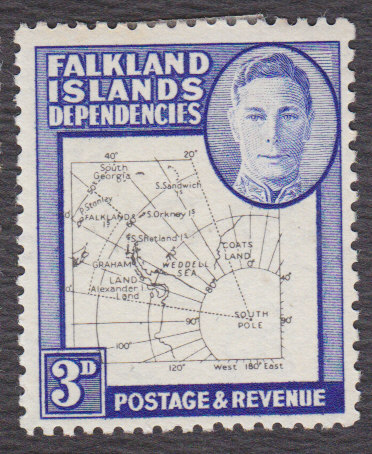
Illustrated below is a partial set of postage stamps for the Falkland Islands and Dependencies during the reign of George the 6th. The set was issued in 1946 and the values were 1 halfpenny (black and green), 1 penny (black and violet), 2 penny (black and carmine) 3 penny (black and blue), 4 penny (black and claret), 6 penny (black and orange), 9 pence (black and brown), 1 shilling (black and purple). The watermark was multiples of CA sideways. The set had many faults with missing letters, "extra islands", with the map being redrawn again to correct some of the faults.This set was issued in 1948 with the map drawn thinner and clearer. Below are illustrated the halfpenny, 2 penny/halfpenny,(added in 1949) 3 penny, 9 pence and 1 shilling values of this issue. Below that are some details showing another fault, the map not aligned properly and printed so overlapping the border and stamp value. With the 1 shilling showing the proper alignment. This set has a higher value than the original issue.




Pitcairn Islands Postage Stamps of George the 6th
Illustrated below is a partial set of Pitcairn Islands postage stamps issued in 1940 in the reign of George the 6th. The set contains values 1 halfpenny (orange and green), 1 penny (mauve and magenta), 1 penny/halfpenny (grey and carmine), 2 penny (green and brown), 3 penny (yellow-green and blue), 4 penny (black and emerald-green), 6 penny (brown and grey-blue), 8 penny (olive-green and magenta), 1 shilling (violet and grey), 2 shillings and six pence (green and brown), The 3 pence issue is known to exist with watermark inverted and can command a very high price. Illustrated here are the halfpenny, penny, penny/halfpenny, 2 penny, 3 penny and sixpence values. Below them is an illustration of the watermark used for the issue.


Locating the Plate Number on the British Penny Red Postage Stamp
Illustrated below is an example of the British Penny Red postage stamp. The plate number is located on the side of the stamp within the linear curves running down the edge of the stamp, The first example shows the plate number 157. The second example shows the plate number 160. The numbers can be located on both left and right edges of the stamp. Plate numbers were introduced on April 1st 1864.


Tuesday, July 26, 2011
Postage stamps of the Japanese Occupation of Burma during World War 2
Illustrated below is a partial set of postage stamps issued by Japanese occupation forces in Burma during World War 2. Issued in 1943 and litho'd by G Kolff & Co of Batavia. The values were a 1cent (red-orange), 2 cent (yellow green), 3 cent (deep-violet and variety in bright-violet), 5 cent (carmine), 10 cent (blue),15 cent (red-orange) 20 cent (yellow-green), 30 cent (olive-brown), 1 rupee (red-orange) and 2 rupee (bright-violet). The illustrations used for the stamps "A Burmese Woman" "An Elephant Carrying a Log" and "A Watchtower in Mandalay". Missing from the illustrations below are the 1,3 and 10 cent issues.


Subscribe to:
Posts (Atom)